Why can some processes be delegated to AI at 99% and others only at 50%?
After designing more than 110 processes with AI, I found the pattern that explains why some get delegated almost entirely and others only halfway.

It’s the first business day of the month. It’s 11 p.m. and you have three screens open: the bank’s platform, the ERP and a spreadsheet with hundreds of rows marked in red. You have to close the month for your company: reconcile payments, analyze trends, fix errors, estimate cash and send the report to the leaders who need to make decisions before 8 a.m.
Then a $14,000 discrepancy shows up from payments that weren’t planned, and you barely sleep trying to sort it out. You do, but you end up exhausted, and it’s only the first day of the month. Just like last month.
The cost goes beyond that night. The next day, you show up tired to the meetings where decisions are made about those very numbers. The analysis your leaders needed from you (which expenses are growing, where the cash is going, what should be adjusted) has to wait until you have time. And that time rarely comes.
That’s what many people feel when they have to run long, difficult processes against the clock.
Everyone wants to delegate, but not everything gets delegated
Over the past year, I’ve worked side by side with dozens of people from companies in different industries, and I’ve been surprised by how motivated they are to delegate what stresses them out the most and, in their words, what drags down their “happiness.” When we offer them the chance to delegate to AI, they’re the first to raise their hands.
Even with that much motivation, only some processes get delegated to AI almost entirely, while others get delegated only halfway. What’s the difference?
Two hypotheses that didn’t hold up
First hypothesis: the easy stuff. A year ago, I thought it would be the easy, routine tasks: sending an email, generating a report, analyzing a document. It made sense: simple things should be the first to be automated.
But practice showed me something else. The month-end close, which is long and full of calculations, was delegated almost entirely. And replying to an upset customer’s email, which takes five minutes, stayed in the person’s hands.
Second hypothesis: the chaos. Then I thought the difference was in the exceptions: whatever has exceptions doesn’t get delegated. But there were processes full of exceptions that were delegated completely.
An invoice with an amount different from the purchase order is an exception, and it still has a clear rule: if the difference is under 2%, it’s approved; if it’s higher, it gets reviewed. AI resolves it without hesitation.
What decides how much gets delegated?
After designing more than 110 processes with AI, I’ve found a pattern that has nothing to do with whether the process is easy or how stressful it is.
The difference lies in how many correct answers each task in a process has.
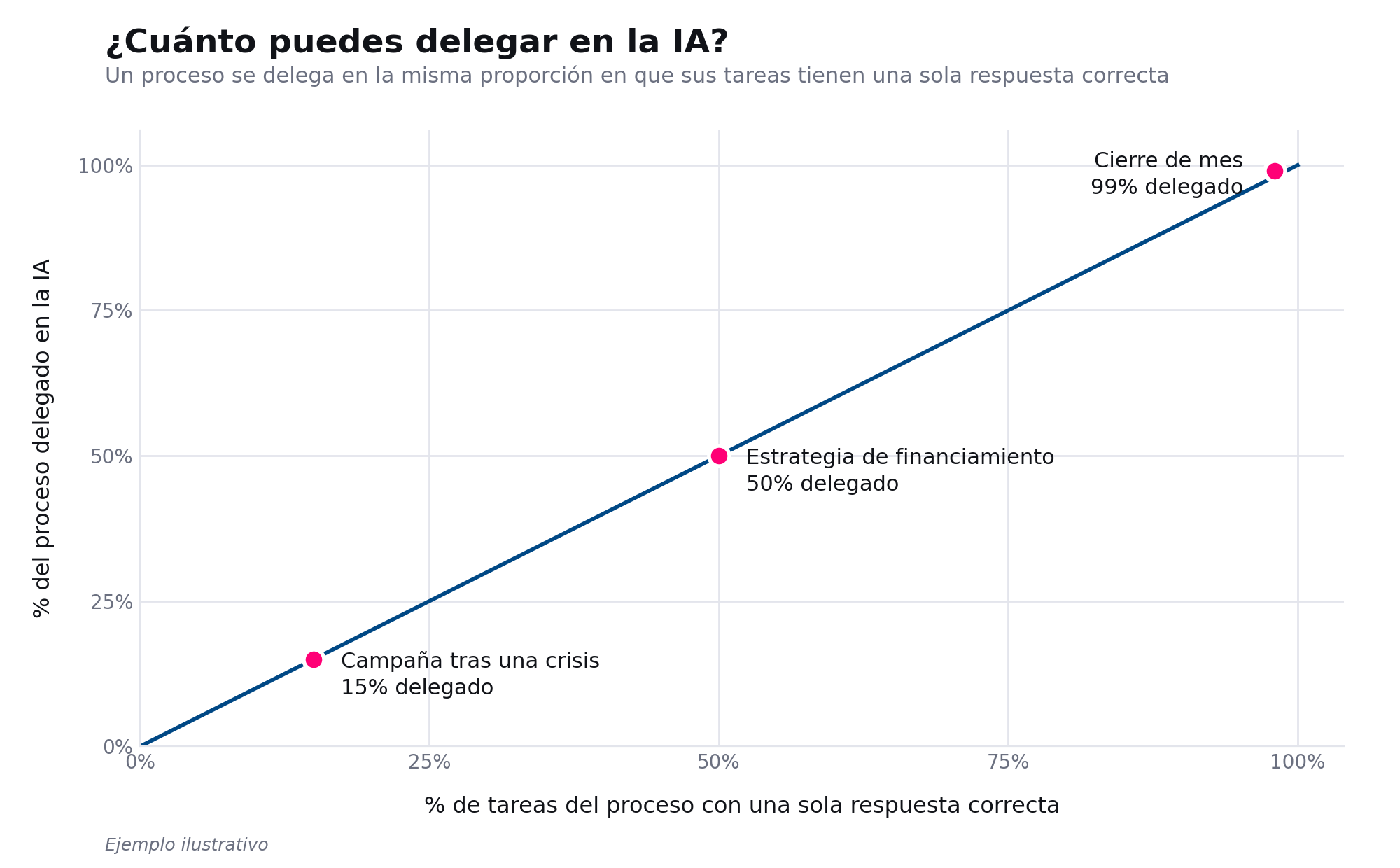
It doesn’t matter how complex it is, how long it takes, how many sources have to be checked, how much data has to be processed or what logic has to be followed. If a task has only one correct answer, 99% of it can be delegated.
Single-answer tasks: 99%
Matching each payment to its invoice has only one correct answer: either they match or they don’t. Calculating the tax on a sale, consolidating cash across three bank accounts or comparing this month’s spending with last month’s do too.
That’s why the month-end close gets delegated almost entirely: AI calculates the trends, spots which expense went up and by how much, and delivers the analysis ready to use. What to do with that analysis is a different task, and that one belongs to the person.
When I say 99%, I’m talking about time. What used to take a person a full day now takes the minutes they spend reviewing and approving.
Judgment tasks: 50%
In many processes, the activities have multiple correct answers. For example, if the same person in charge of the month-end close has to come up with the financing strategy for a new project, they’ll have several options: use cash, take out a loan, look for investors.
To reach the answer, they can delegate the analysis to AI, but they’re the one who decides, and that takes time: reading, analyzing, weighing pros and cons. That’s where a process stays at 50% or even less.
AI can project cash flow under each option, calculate the cost of the loan at different rates and show how much of the company would be given up in an investment round. What it can’t know is how much risk the board is willing to take, how good the relationship with the bank is or whether the main partner is thinking about selling in two years.
All three options are correct. The best one depends on things that live in people’s heads.
The same thing happens in marketing. After a reputation crisis, the team has to define the storyline for the campaign to reposition the brand. AI can analyze thousands of social media comments, find what upset customers and write three different storylines: apologize and show concrete changes, return to the brand’s founding values, or look ahead with a new announcement.
All three can work. Choosing one depends on how exposed the company is willing to be, what it promised before and how ready it is to deliver on what it says.
The two-expert test
There’s a simple test to recognize a judgment task: if two experts could do it differently and both be right, the task has more than one correct answer. The email to the upset customer passes that test. Payment reconciliation doesn’t.
The month-end close, redesigned
This changes how you design a process. Single-answer tasks are delegated with clear rules. Judgment tasks are framed as a clear question for the person: short, with the options already analyzed and ready to decide in minutes.
Back to the month-end close, now delegated to AI: it’s 5:45 p.m. and the process has spent hours matching payments to invoices. At 5:50, it finds the same $14,000 discrepancy.
It follows the defined steps, but there are three payments without clear documentation and more than one correct way to record them. Instead of guessing, it stops and writes to the person in charge:
“I found a $14,000 discrepancy in three payments without an invoice. Option A: record them as operating expenses, based on the vendor’s history. Option B: hold them in accounts receivable until the invoice arrives. Which one should I apply?”
She reads it on her phone and chooses B. That same morning she spoke with the vendor and knows the invoice is on its way, a piece of information the AI didn’t have. It takes her three minutes.
The AI picks the process back up. At 6:30, the person in charge of the monthly close heads home or, better yet, to happy hour, because the reconciled reports have already gone out.
The 50% paradox
A person who delegates 50% of a complex task like analyzing a financing strategy will feel it’s a big leap in their work, and that they can spend those hours thinking and deciding better. It feels the same as delegating 99% of the month-end close.
The reason is that it’s exhausting to do lots of short tasks to reach a decision: finding the data, organizing it, calculating, comparing. When AI does that part, the person keeps the part of the work that makes them valuable.
What should you ask before delegating a process?
If you’re thinking about delegating processes to AI, ask yourself how many correct answers each of its tasks has, and not how complex it is to get to them.
Difficulty is no longer the barrier.